What a Gold Assay Result Actually Tells You
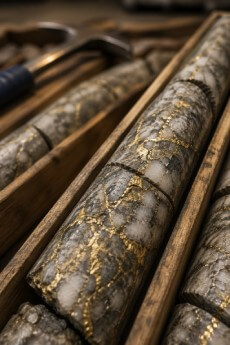
Many production procedures are used in different industries or laboratories to quantify the chemistry of a given sample through chemical extraction of the products into the analysis. This test is then called an analysis. If you eventually receive an assay report from an exploration company that says, "8.7 g/t Au over 4.2 meters," all aspects of this utterance must be unpacked before making any judgment about it.
"Au" stands for gold in chemical terms. "g/t" denotes the grams of gold in gold rock content, and its interpretation varies from "per tonne of rock" to "in drilled material." In this case, 8.7 g/t means 8.7 grams of gold were included in the one tonne of rock that was drilled. The "4.2 meter" is the length drilled over which the grade was monitored with a core section.
Here's where beginners get tripped up. That single reported number is almost never one sample. Geologists composite multiple individual samples along a drill hole and report a weighted average. A 4.2-metre intercept might represent six separate 0.7-metre samples with grades ranging from 2 g/t to 22 g/t. The headline number smooths all of that out.
Reading a result responsibly means asking what's underneath the average. Was the high grade concentrated in one narrow sample? Does the company report individual sample intervals somewhere in the release? Those details tell you far more than the headline intercept alone.
Why Grade and Width Must Be Read Together
A lone high number generally does not tell the whole truth. Forty-five g/t gold might sound impressive when a company reports this kind of value, but 0.3 m of strike length. Narrow high-grade intersections are important; however, prior to excitement about such values, they need geological context.
We can only speculate when comparing two results in one project: 12.4 g/t over 1.8 metres and 2.1 g/t over 18 metres. The first provides a higher grade but is very localized, whereas the second intercepts much larger bits. Roughly multiplying grade by width gives a rgtional grade-times-thickness figure ranging around 22.3 and 37.8, suggesting that the broader intercept could carry greater weight. It is important to note that such calculations are only indicative of making any sense but are absolutely not an alternative to actual resource estimates. Rather, they show the investor what to see in one instance compared to other incidences without being enchanted by headline grades.
There is one other level of complexity usually glossed over in most press releases. The width given in an assay represents the drilled interval and it is not always reflective of the actual width of the mineralized zone. True width is the actual thickness of the zone measured perpendicular to its orientation. In other cases, when a drill hole intersects the mineralization at a shallow angle to the zone, the measured width can be much longer than the true thickness. For example, a 10-meter intercept might have just 5 or 6 meters of actual mineralization. Sometimes companies provide true width estimations; when they don't, the wider intercepts should be very carefully examined.
How to Judge Whether an Intercept Has Real Exploration Significance
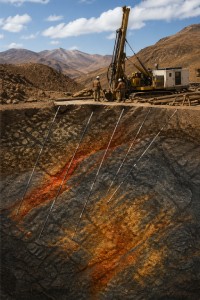
One strong hole rarely tells the whole story. What separates a meaningful discovery from a press release is whether that result repeats across multiple drill holes with consistent grades and similar widths. Continuity matters. A single 12 g/t intercept is exciting; three adjacent holes showing 8–14 g/t over comparable widths suggests something real.
Check where the hole was drilled relative to the target area. A hit near the edge of a modelled zone is less encouraging than one confirming the core of it. The deposit model – the expected geological style of the mineralization, whether it's a shear-hosted vein system or a bulk-tonnage disseminated deposit – determines what "good" actually looks like. Near-surface ounces in a disseminated system can support open-pit economics. The same grade at 600 metres depth in a narrow vein is a different conversation entirely.
Read the Whole Report Before You Read the Headline
Discipline separates investors who tie assay results together into a story from those who just chase numbers and get burnt. Run a quick mental checklist when an exploration announcement comes through. Frameworks of first things first: Read into units ( i.e., "g/t" means grams of gold according to tons of rock, and meters stand for the length of drilled mineralized materials). Make sure that the grade is then in relation to the width; that is, some cases of 1.2 g/t over 48 metres can be twice as valuable as 14 g/t over 0.9 metres. Check for true width statements: drilled intercepts nearly always exaggerate the thickness of the vein or shear zone present. Also, it does not only the best intercept that shows the validity of the others. Geological continuity, or how mineralization runs between predictable drilling from hole to hole, is the best measure. And further, assay results are signals, not stand-alone evidence of a deposit's worth. But reading guarantees success in the investment game-when consistent.
Quick Links
🇨🇦 Newfoundland and Labrador just became one of the hottest mining jurisdictions in Canada.
— Juniorstocks.com (@Junior_Stocks) November 24, 2025
Record exploration. High-grade discoveries. Valentine Lake’s first pour.
New Found Gold ignited the spark and now the whole province is booming.
The Rock is officially gold country… pic.twitter.com/beJkB2ZNw0
With the kind help from